Wednesday, 26 March 2014

The Ethical Dimension of Non-State Armed Groups (Part II)

Please note that this entry is part of an extended essay written by the author during his internship with the South-South Network on Non-State Armed Group Engagement (SSN). Nevertheless, the opinions expressed in this article are the author's own and do not necessarliy reflect the view of the SSN.

_____________________________________________________________________________________

In part I of my entry on the ethical dimension of Non-State Armed Groups (NSAGs) I attempted to show why research and discussion of these issues matters and described the current state of research. This second part will focus on the theoretical background that is needed in order to introduce NSAGs into the ethical debate.

While policymakers, depending on their political attitude, often label NSAGs as either “terrorists” or “freedom fighters” to put a certain complexion on them, the term Non-State Armed Group is quite neutral and does not preset any normative position. Instead of labeling certain groups according to their actions, I will raise the question if and in what way NSAGs can be considered moral agents, i.e. entities that can be held morally responsible for their decisions and behavior. These considerations will be preceded by a short overview over important terms that are often used in ethical debates.

Ethical Terms - Ethics, Morals, Ethos, Law
In order to discuss ethical matters, some of the key terms need a short explanation. First of all, ethics itself is concerned with justifying moral theories and attitudes. It is, therefore, the science that deals with morals and ethos. For example, Immanuel Kant’s categorical imperative is a moral theory that determines what is good and bad, while the justification of why the categorical imperative should be applied is ethical reasoning. As seen in the example above, some moral theories are normative, i.e. they determine what is right and wrong, while a descriptive understanding of morals would explore existing concepts and look into what a certain society at a certain point in time accepts as generally good or desirable respectively as evil/bad/wrong and prohibited. A subcategory of morals is ethos, the moral attitude of a person or group. Finally, law consists of codified and compulsory norms including sanctions. In some societies, law and morals are very close or even identical, even though this is rather the exception than the rule. For example, certain aspects of administrative law are hardly based on moral intuition but more likely on rational considerations.

Moral or Social Responsibility of NSAGs?
First, as a matter of principle, moral agency requires the agent’s ability to make moral judgements and act with reference to right and wrong. NSAGs are usually hierarchically structured organizations composed of human beings. Successful NSAGs do not only engage in armed violence, but are also capable of raising funds, long-term strategic planning, logistic support and recruiting new members, skills that indicate that the (decision-making) leadership of NSAGs is sufficiently rational, a widely accepted precondition for moral agency. It is disputed, though, if being able to make moral judgements is equivalent with being required to actually do so, as some scholars hold that only actual people, not artificial organisms can have moral responsibilities. In the field of business ethics, this debate is ongoing for decades, with Nobel Prize winning economist Milton Friedman as protagonist of the idea that "there is one and only one social responsibility of business–to use it resources and engage in activities designed to increase its profits so long as it stays within the rules of the game, which is to say, engages in open and free competition without deception or fraud."

Portrait of Milton Friedman
Friedman does not speak of moral, but of social responsibility, an entity’s obligation to act to benefit society at large. Since he holds that enterprises benefit society simply by increasing their profit, this is their only social responsibility. It is however important to highlight that the fact that society profits from the success of its companies is rather a positive byproduct than the initial objective of business.

The question if an organization can be a moral agent depends on the understanding of morality itself. In a descriptive sense, morality is a means to make a human society function. From a historical perspective, the first organizations were of political and religious nature and oftentimes served the very same purpose, to enable and guide growing societies, intentionally or not. The invention of business entities created a new kind of organizations. Their purpose is not to benefit the society at large, but primarily their owners. However, because business entities offer solutions to societal needs (like products, services, jobs), their efforts happen to have positive effects on the society they operate in, which is precisely the “social responsibility” of business that Milton Friedman had in mind.

To sum up, rational individuals are moral agents with moral responsibilities, at least when they choose to live in a society, while traditional political organizations (governments) serve a similar purpose than morality. Since they are composed of rational individuals and act on behalf of their people, they are oftentimes required to act morally, too. Business organizations, however, do not share this moral responsibility, because they serve a different purpose. To ensure that they do not cause harm to a society, they are bound by laws. Nevertheless, many people demand social responsibility of business enterprises that goes beyond legal regulations because their conduct might have negative effects on societies that are hardly restrictable by law. If businesses are actually obliged to a socially acceptable conduct beyond legal regulations remains a matter of debate.

To integrate NSAGs in this system, the focus has to be on their (self-given) purpose. Many NSAGs are motivated by a certain or several grievances that are usually caused by the (in their perception) incompetence or morally objectionable behavior of the responsible governments. In case of the former justification, NSAGs argue that their political leaders could ensure a social coexistence (of their peer group) preferable to the current one, while in the case of the latter, ethical justification of their insurgency, NSAGs make themselves quasi moral agents as they show the capability to decide between good and bad and request moral behavior from others.

Of course there might be other motivations for NSAGs as well. Economic theories often treat insurgencies as criminal acts with the objective to gain power over natural resources or even hold that “where civil war is feasible it will occur without reference to motivation” (p. 2), a position that is not undisputed (See for instance here and here). In fact, some NSAGs use abduction on a massive scale to fill their rows. For example, almost 88% of the fighters of the Revolutionary United Front (RUF), a major NSAG during Sierra Leone’s Civil War, reported that they were abducted (p. 438). This is a clear sign that not all or only very few of the members of such NSAGs are motivated by societal grievances. One the other hand, events like the Arab Spring and its aftermath impressively demonstrate that the emergence of NSAGs as well as the associated insurgencies, violent conflicts and even civil wars can be motivated by grievances like experiences or perceptions of injustice. In the following I will focus on NSAGs with this sort of background because I regard any discussion of the ethical dimension of fundamentally inhuman, extremely cruel, exceedingly avaricious and alarmingly irrational non-state violent actors as redundant. This means that terrorist groups are also excluded from the following considerations as the immense immorality of their means - killing noncombatants to spread existential fear among a certain group of people - blocks the way for any further ethical discussion.

The leader of Uganda's Lord's Resistance Army rebels, Joseph Kony, surrounded by his officers in Nabanga, Sudan, August 1, 2006. Image Source: Reuters
A short excursus: fundamentally inhuman, extremely cruel, exceedingly avaricious and alarmingly irrational NSAGs
One example of high-level irrationality among NSAGs is the leadership of the so called Lord’s Resistance Army (LRA) that originates from Uganda and operated in Sudan (now South Sudan) and countries in Central Africa. Let me quote two news articles that illustrate what I mean by such NSAGs. You will certainly understand why I believe that any discussion of their ethical dimension is futile: “The rebel group began in 1986 as the Holy Spirit Movement, a Christian fundamentalist revolt under the leadership of a cult leader, Alice Lakwena, who claimed to give her followers immunity from bullets by anointing them with holy water”, while the current leader of the LRA, Joseph “Kony is a former faith healer who wears white robes and claims to talk directly to God. His followers embrace an eclectic group of beliefs, including prohibitions against riding bicycles, killing pigs and eating white-feathered chickens. Punishment is severe: the rebels have chopped off the feet of young men caught riding bicycles.” Furthermore, Mr. Kony “has nurtured a cult of personality, claiming he is visited by a multinational host of 13 spirits, including a Chinese phantom. Former abductees speak in awed terms of his "magical powers" and abrupt mood changes.” You can find the full articles here and here.

The interim result
NSAGs that are motivated by a certain grievance usually have the objective to eliminate this grievance for the benefit of their peer group. They are willing to fight an evil with another evil, i.e. armed violence and its harmful consequences. Given that the grievance that motivates them is real and can realistically be resolved by the use of force, the insurgents will most likely presuppose that the end justifies the means and, therefore, consider themselves as moral actors. As a political organization, they want to enhance a dysfunctional society. In this respect both NSAGs and governments serve a similar purpose than morality - at least from a very pragmatic and un-metaphysical perspective. They are, therefore, not moral agents with moral responsibility in the same way that individuals within a society are, but are still bound by the moral values of the peer group they are fighting for - similar to official governments. The term social responsibility does not apply to NSAGs as it is usually used in the context of organizations which’s actions are not primarily intended to affect a given society in any way, e.g. business enterprises. 

Thursday, 20 March 2014

The Russians Are Coming : What You Need to Know About the Ukrainian Crisis

DISCLAIMER : This article was prepared or accomplished by the author in his personal capacity. The opinions expressed in this article are the author's own and do not reflect the view of the Foreign Service Institute, the Department of Foreign Affairs, or the Philippine government. 


That time of the month folks so get your nerd on and dive right in ! Today we talk about the Ukrainian crisis and the Russian Federation's annexation of Crimea, a part of Ukraine. These past few weeks have stunned the most bookish international relations experts and took everyone and his dog by surprise with Russia basically saying nyet to everybody and anybody complaining, so allow me to walk you through the basics. As usual please leave any comments, criticism, or questions at the comments section at the bottom of the page


 Right, let's get straight to it. Let's start off with a brief timeline of the Ukrainian crisis I pirated off BBC :

  • 21 Nov 2013: Russian-leaning Ukrainian President Viktor Yanukovych abandons an EU trade deal in acquiescence to Russian pressure  
  • Dec: Start of Ukrainian Revolution. Pro-EU protesters occupy Kiev city hall and Independence [Maidan] Square
  • 20-21 Feb 2014: At least 88 people killed in Kiev/Kyiv [capital of Ukraine] clashes
  • 22 Feb: Mr Yanukovych flees; parliament removes him and calls election
  • 27-28 Feb: Pro-Russian gunmen seize key buildings in Crimea. 
  • 6 Mar: Crimea's parliament votes to join Russia
  • 16 Mar: Crimea voters choose to secede in disputed referendum [95%]
  • 17 Mar: Crimean parliament declares independence and formally applies to join Russia
  • 18 Mar: Russian and Crimean leaders sign deal in Moscow to join the region to the Russian Federation

What's this deal about, the one Ukraine was about to sign with the EU ?

It's basically a negotiation between Kyiv and Brussels that bestows economic rights on Ukrainians many EU citizens already enjoy : higher freedom of movement of businesses and peoples within EU countries, elimination of customs and barriers to trade, EU investment in Ukrainian cities, the works. On paper this seems like a pretty fair and non-political deal, but a big loser in all this would have been Russian President Vladimir Putin who would like to keep the Ukrainian economy tied to Russia's. Russia has always viewed itself as fundamentally different and a counterweight to the perceived hegemony of first Western Europe and then the United States. In addition, there is a real fear in Russian circles that such an economic deal might lead not just to a political one [e.g. full EU membership for Ukraine], but also to a military one [e.g. NATO membership]. 


NATO expansion as of 2011, with former Soviet republics Ukraine and Georgia in membership discussions. With Ukraine right on its border, Russia sees Ukrainian accession to NATO as a threat to its national security.
(Source : Phil Ebersole)


NATO, if you recall, was the military alliance mainly of the United States and Western Europe to combat the Soviet Union back during the Cold War. Well, the Soviet Union collapsed but NATO didn't and has even since expanded ever closer to Russia's border, something which Mr Putin resents. Since Russia perceives Ukraine as firmly being in its backyard, its sharp and aggressive reaction becomes, if not sympathetic, more understandable in such a context. I explain why Ukraine represents a red line for Russia in this other article. 

What is the Crimea ? 

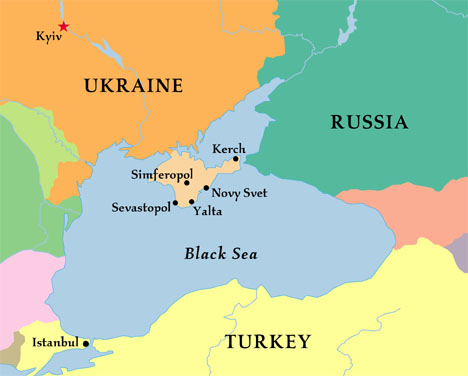
The Autonomous Republic of Crimea is/was a part of Ukrainian territory, a peninsula jutting out into the Black Sea. A look at a political world map will tell anyone of its geo-strategic importance. It houses both the Russian Black Sea Fleet and, until recently, the Ukrainian Navy. In addition, Russia maintains soldiers, bases, and other military assets in the region, as stipulated by an agreement between Russia and Ukraine signed in the 1990s.
Crimea contains the historically and militarily important port of Sevastopol. Controlling it allows greater control of the Black Sea and greater access to the Bosphorus (Turkey) and the Mediterranean Sea.
(Source : Consortium News)

Formerly Russian territory dating back to Catherine the Great in the 18th century, it was gifted by then Soviet leader Nikita Khrushchev to Ukraine from Russia in 1954, presumably as a token of friendship. This is why there are many ethnic Russians and Russian speakers who live in the region and comprise the majority ethnic group here. Yet because both Russia and Ukraine were then part of a single country, the Soviet Union, this didn't really matter especially in the international sphere. Sort of like how the ongoing spat between the cities of Taguig and Makati over who owns Bonfiacio Global City will ultimately not amount to much in the international arena since it's all still territorially part of the Philippines anyway. Of course, the Soviet Union has since dissolved, and a legacy of which is that Crimea remains today part of Ukraine -- well, not anymore for the Russians. 

How were the Russians able to "invade" Ukraine ? Is it true that they did it without firing a single shot ?

The "invasion" was remarkable because Russia was able to snatch a sovereign part of Ukraine without the accompanying violence or bloodshed associated so much with military action save for the killing of a single Ukrainian serviceman just recently. Now, I keep using the quotation marks for "invasion" because from the Russian perspective they don't see it as an invasion; instead, their version is that local "self-defence units" or civilian volunteers composed of local ethnic Russians were the ones responsible for seizing important government buildings and besieging Ukrainian soldiers in their bases. While this isn't entirely untrue, it's a really ridiculous claim since, aside from many local Crimean Russian civilians genuinely in favour of Russian annexation, a lot of these self-defence units wear Russian military uniforms, carry Russian weapons, drive Russian vehicles with Russian plates, and speak Russian. Also, they appear extremely well-trained and organized for a supposedly militia outfit. What enables President Putin to distance himself from these troops is that they don't wear Russian military insignia on their uniforms, and he insists they are locals who must have gotten hold of the uniforms in stores.
They may be armed with sophisticated weaponry and look dangerous, but they can't possibly be military because they don't have those shiny Russian buttons.
(Source : Global Post)

Further complicating the issue is the existence of Russian bases on Crimean territory owing to the bilateral agreement I mentioned earlier. After the breakup of the USSR, Ukraine and Russia worked out a deal that saw Russia leasing Sevastopol, the all-important naval port, and other important military facilities until 2042. The treaty further stipulates that Russia can host up to 25,000 troops and other materiel within these bases, and so it's easy to conclude that a lot of these uniformed men have come from these bases and have taken direct orders from Moscow. That's one reason why this "invasion" was so perfectly executed since Russian troops were already in the vicinity anyway.

Of course you might be thinking, well that's pretty dumb of the Ukrainian government to have signed the treaty, but hindsight's always 20/20; nobody could have foreseen the current explosive situation since Russia and Ukraine have traditionally enjoyed warm relations. So strictly speaking, the existence of Russian troops on Ukrainian and specifically Crimean soil doesn't amount to invasion; it's the fact that these troops have gone out of their bases and occupied cities and bases all over Crimea that have riled up international legal experts, along with the controversial referendum.

Do Crimeans actually want to be part of Russia ? 

Around 60% of Crimeans are ethnic Russians, and it's an even greater percentage for Russian speakers. That said, not all Crimean Russians want to be part of Russia, and it's hard to see Crimean Ukrainians and Tatars, another local ethnic group, sharing Mr Putin's vision. 

It doesn't help either that Ukraine's new interim government possesses nationalist and extremist far-right members. What's worse is that early on after Yanukovych's ouster, these nationalists passed a language bill which banned Russian as an official language. Not a good political move since it only angered Russia and justified the latter's right to intervene on behalf of its citizens against Nazi and nationalist elements. Another fallout is the unrest spreading also in Ukraine's eastern regions, centered on the cities of Kharkiv and Donetsk. These were also formerly Russian cities and contain lots of ethnic Russians as well, and they have seen their Crimean brethren act and have been ratcheting up the clamour for reunion with Mother Russia as well. This is actually what the West fears the most right now : a general invasion of Ukraine's eastern region (since Mr Putin appropriated the "right" to invade Ukraine if Moscow feels that Kyiv isn't doing enough to protect ethnic Russians) and the spark for a wider European war. 

Is the referendum legal and does Putin have a basis for subsequently annexing Crimea ?

International law guarantees that people have a right to self-determination. This was upheld and confirmed by an International Court of Justice (ICJ) ruling. Essentially, self-determination means that a nation or a people has the right to choose its own sovereignty and political status. This was used by many countries in the past in to justify their existence : South Sudan, Kosovo, and even the Philippines (and also the Bangsamoro people). It is in this manner that Russia justifies its annexation of Crimea since, according to the Russian narrative, the initiative came from the Crimean people themselves through the holding of the referendum, and that Russia but only acted accepted the democratic wish of the Crimean people.

At the same time, international law also guarantees the territorial integrity of states, meaning that international borders are sacrosanct and that no outside state has any right to exercise undue pressure on other countries to effect border changes -- something which the Russians are clearly guilty of despite their insistence on innocence. This opposition of two conflicting objectives -- self-determination and territorial integrity -- has always been a headache for many international relations scholars. Also, at a national level, Ukraine's constitution doesn't allow for separate, localized referenda on state issues such as secession; these can only be done at a whole, national level, meaning non-Crimean Ukrainians also have a legal say in the future of other parts of their country.

So what's the international community doing about it ? 

As expected, the West is outraged and waxes indignant by what it sees as a blatant land grab and a grave violation of the international order. Western critics have made emotional appeals to the world community comparing Russia's move with Nazi Germany's annexation of parts of Czechoslovakia. The US and EU have already imposed asset freezes and visa bans for lower-ranking Russian officials and have threatened deeper economic sanctions if Russia doesn't desist. They have, however, ruled out a military option; I'd say they're not too keen on fighting an all-out war with a nuclear-armed Russia, so you can rest easy that World War Three's not coming any time soon. 

More interesting are China's and to a lesser extern India's reactions. Last week the United Nations Security Council voted on a resolution drafted by the United States declaring the referendum invalid. Even though Russia used its veto, the vote was telling since all the rest of the members voted for the resolution, politically isolating Russia. Well, everyone except China, which abstained. 

What gives ? The Chinese vote is in essence a balancing act. On the one hand, China and Russia are strategic partners cooperating in many areas. China sees Russia as a useful counterweight against American hegemony and intrusion into its own backyard -- the South China Sea/West Philippine Sea. It also resents Ukraine's revolution and the toppling of Mr Yanukovych since these also represent a threat to its own Communist Party-led regime. 

On the other hand, China doesn't want to antagonize the Americans outright. It still has all these lucrative trade and financial links with the West that make it the second biggest economy in the world. Furthermore, Russia's actions also threaten unrest within China's own borders. Remember that little kuento earlier on territorial integrity and self-determination ? China has restive minorities itself in Tibet and Xinjiang, and thus outright supporting Crimean separatism would breathe new life into China's own separatists. As a rule of thumb, Chinese foreign policy is dominated by the principle of non-interference in other states' domestic/internal affairs. Walang pakialamanan

And so it is that China is taking the path of least resistance: abstaining. 


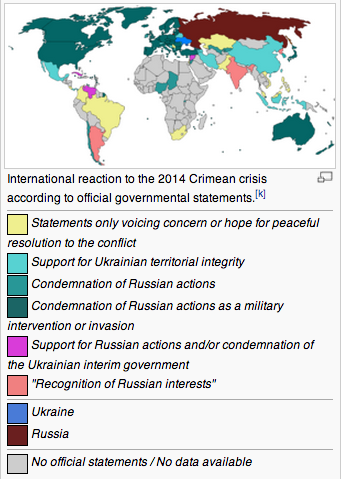
A really neat infographic that sorts out countries' positions on the annexation. Only Cuba, Venezeula, and Syria (and I think North Korea ? Can't see clearly) fully support Russia's actions. Philippines is yellow.
(Source : Wikimedia Commons)

This is getting long again. Just tell me what to expect in the coming days. 

I can't tell you that but I can give you a general feel of the direction.

I mentioned earlier the possibility of Western economic sanctions. Trouble is, this cuts both ways. Russia has threatened economic retaliation of its own, and since Russia is the largest trading partner of the EU -- it exports a ton of its natural gas and oil to Europe -- the Europeans aren't as keen as their American allies in rushing for sanctions.

Russian-American diplomatic cooperation will probably suffer in other arenas too. Weapons proliferation, terrorism, Iran's nuclear programme, the Syrian Civil War, you name it. Whether the White House likes it or not, Russia still has significant heft in the international arena.

Finally, the Chinese will be closely watching developments in Europe as well. As I mentioned earlier, any distraction for the United States is welcome so they can have a freer hand acting against the Philippines and Vietnam. And if the West fails to give a strong and unified response to Russia, the Chinese (and the Iranians, Venezuelans, North Koreans, and Syrians with them) will take that as a sign of Western weakness and American decline and reluctance for conflict, boosting even more aggressive actions in certain parts of the world. 

I only hope that Filipinos don't pay the price for it. 

Monday, 17 March 2014

The Russians are Coming : Understanding the Russian psyche

DISCLAIMER : This article was prepared or accomplished by the author in his personal capacity. The opinions expressed in this article are the author's own and do not reflect the view of the Foreign Service Institute, the Department of Foreign Affairs, or the Philippine government. 

The last few weeks have been abuzz with news on a hitherto minor country with little exposure to the media and much of the general Philippine public. In the international press, this issue, along with the search for the missing Malaysian commercial jet, has effectively overtaken the Syrian Civil War in terms of coverage.

Events have moved at a lightning pace and took everyone by surprise, with fears of a new World War exploding once again in Europe. 

To get a grip on the whole mess, let's take a quick trip down memory lane and see why Ukraine matters so much. 

Ukraine as a political, independent, and sovereign entity didn't exist right up until the dissolution of the Soviet Union in 1991. Previously it was ruled by various foreign powers throughout much of its history. You had the Austrian Empire ruling large tracts of western Ukraine centered on the city of Lviv after it conquered it from Poland-Lithuania, before reverting back to Poland again after World War One and coming under the Soviet Union in 1940 and part of modern Ukraine in 1991. Then there's the Crimean Peninsula, centre of the confrontation between the West and Russia, which was formerly under the rule of the Tatars allied to the Ottoman Empire (modern-day Turkey) until Russia under Catherine the Great annexed it in 1774. The eastern portions of Ukraine were also formerly under the rule of imperial Russia. Crimea remained a part of Russia until February 1954 when it became part of Soviet Ukraine. And Kiev/Kyiv, capital of Ukraine, was once part of the Russian Empire as well. Its importance is underscored by the fact that it is considered the birthplace of Russian civilization and of the Russian Orthodox Church, the religion of many Russians and other Slavic and Eastern European peoples.
Modern Ukraine.
(Source : Wikimedia Commons)
That's a mouthful.

It certainly is, so let's break each part down to see the consequences.

In 1954, then Soviet premier Nikita Khrushchev decided to gift Ukraine with Crimea as a token of friendship between the Russian and Ukrainian peoples. Substantively, this didn't matter much anyway since both the Russian Soviet Federative Republic (SFR) and the Ukrainian SFR were part of the same sovereign state or "country", the Soviet Union. Kind of like how the ongoing spat between the cities of Taguig and Makati over who owns Bonifacio Global City will ultimately not amount to much in the international arena since it's all still territorially part of the Philippines anyway. Little did they know that the USSR would collapse decades later and now cause an international crisis. This is why today there are many ethnic Russians living in Crimea, composing 58% of the population compared to 24% Ukrainians in a 2001 census.

(Source : Wikimedia Commons)


Further complicating the situation are the mostly Muslim Tatars who make up a sizable minority (12%) with deep roots in the region. As earlier mentioned, Tatars, an ethnic group related to modern day Turks (which introduces yet another variable into the equation : Turkey's involvement and its role as a NATO member), were once the dominant local people ruling the peninsula. After Russia conquered it, the Tatar population steadily decreased to 34% in 1897, to 19% in 1939 on the eve of the Second World War, to a horrifying zero percent after the war. This reflected then Soviet dictator Joseph Stalin's brutal policy of deportation and ethnic cleansing as collective punishment for collaboration of some Tatars with Hitler's Nazi Germany. They have since been allowed back to their homeland, yet the memories of repression have ingrained in them a knee-jerk suspicion of Moscow's power, which is why a lot of them chose to boycott the referendum and wish to remain with Ukraine.

So Crimea is important to Russia for military and historical reasons. Why is the rest of the Ukraine tearing up as well ? 

I mentioned earlier the historical, almost sacred, significance of Kyiv. It is the birthplace of the Kievan Rus, the first Slavic state from which Russians and Ukrainians, both Slavic people, draw their ancestry and heritage. In fact, the Russian and Ukrainian languages are very similar and both employ the Cyrillic alphabet (think of how the various Philippine ethnic groups have similarities and common heritage and languages with Indonesians and Malaysians). This is why, in the Middle Ages, Ukraine was sometimes called Little Rus or Little Russia. The word "Ukraine" itself is said to mean "borderland", reflecting a Russo-centric perspective. It is for these reasons that Russian President Vladimir Putin is loth to see Ukraine join the EU and/or NATO (which is what triggered the whole crisis) since it sees itself as the "big brother" of Ukraine. For him, the latter should thus naturally fall within Russia's orbit as opposed to the West. Many ethnic Russians living in Crimea and the eastern parts of Ukraine feel the same way.

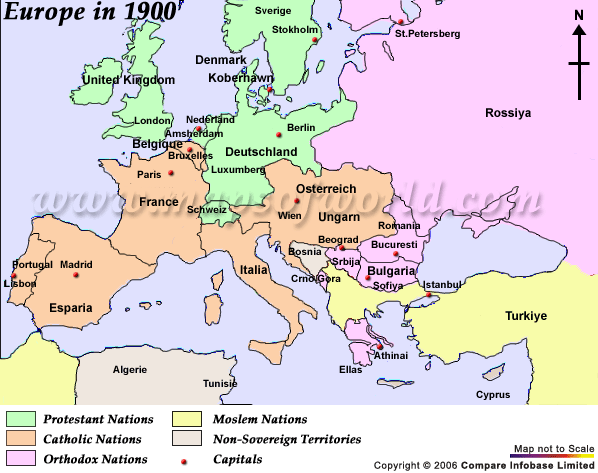
Ukraine and Belarus, both Slavic nations, were once part of the Russian Empire.
(Source : Maps of World)
In western Ukraine, pro-Russian sentiment is not as high as there are less ethnic Russians and people who speak Russian as a first language. As pointed out earlier, this part of Ukraine is traditionally more Western in outlook owing to its history as part of former Western countries like Poland and Austria. In fact, eastern Ukrainian cities look more like Russian industrial towns compared to the western Renaissance architecture of western cities.

Wait, so how did this crisis directly start anyway ? 

I discussed the crisis itself in detail here.
When Mr Yanukovych reneged on the deal, Putin got a temporary, satisfactory victory over a humiliated EU. But this triggered protests all over the country by pro-EU quarters of the population, leading to the heavy civil unrest you probably saw so much on TV and in the newspapers which then lead to Yanukovych's flight from power, to the ushering in of a Western-oriented interim government, and ultimately to the Russian reaction and Crimean referendum. And now we have the Russians and Europeans and Americans in a tense stare-down not seen since the Cuban Missile Crisis, causing an international furore and a huge dip in stock markets.

First, what's this trade deal that started all this scuffle ? It's basically a negotiation between Kyiv and Brussels that bestows economic rights many EU citizens already enjoy on Ukrainian citizens : higher freedom of movement of businesses and peoples within EU countries, elimination of customs and barriers to trade, EU investment in Ukrainian cities, the works. On paper this seems like a pretty fair deal, but a big loser in all this would have been Putin who would like to keep the Ukrainian economy tied to Russia's. Russia has always viewed itself as fundamentally different and a counterweight to the perceived hegemony of first Western Europe and then the United States. 

Indeed, Mr Putin has previously deplored the collapse of the Soviet Union, calling it the "greatest geopolitical catastrophe" of the 20th century not so much because he was a fervent believer in communism, but because he resented the loss of his country's power and prestige. EU proposals that Ukraine join NATO, a anti-Soviet Cold War-era treaty alliance guaranteeing that member states come to the aid of an attacked state, only serve to confirm Putin's worst fears about European encroachment in Russia's backyard; aside from being historically and culturally important, Ukraine is geographically crucial as well since it directly borders Russia; an EU-Ukraine economic deal might be the precursor to a NATO military deal and the installation of NATO missiles and other military assets right on Russia's doorstep. In addition, Ukraine is considered one of the breadbaskets of the world, exporting millions of tonnes of grain a year both to Russia and Europe. 

In this sense, combining all the historical, cultural, and geographical reasons, we get a sense of why Ukraine is an extremely important country and that it signifies a non-negotiable red line for the Russians; if the Russian government is already acting severely intransigent on Syria, a faraway country, it's easy to understand, if not sympathize with, its sharp, belligerent reaction to perceived European meddling in its own backyard. 

A war of words. US Secretary of State John Kerry and Russian Foreign Minister Sergei Lavrov
(Source : Press TV)
Thus despite the West's insistence on it, the current tug-of-war is less an issue on human rights, self-determination, and freedom and democracy, than it is on realpolitik, international prestige, economics, and a revival of Cold War-style splits. The only real losers here are the Ukrainian people caught in the middle of the West's and Russia's power plays. "It is no matter to them if the high lords play their game of thrones, so long as they are left in peace." 


As always, comments and criticism are highly encouraged ! 

Tuesday, 25 February 2014

The Ethical Dimension of Non-State Armed Groups (Part I)

Please note that this entry is part of an extended essay written by the author during his internship with the South-South Network on Non-State Armed Group Engagement (SSN). Nevertheless, the opinions expressed in this article are the author's own and do not necessarliy reflect the view of the SSN.

_____________________________________________________________________________________

MILF insurgents in Mindanao, Philippines. Image: Keith Bacongco
Combining my academic background (philosophy/ethics) with my area of work and interest (security issues), I will explore a topic that has not yet attracted much attention by scholars, researchers or the public. While there are considerable research efforts in the field of military ethics (take for example the quarterly Journal of Military Ethics) that is concerned with ethical considerations of national armed forces, the ethical and moral dimension of Non-State Armed Groups (NSAG, also known as Violent Non-State Actor, VNSA) is characterized by a severe shortage in research. This is not surprising, considering that the majority of researchers in this field are based in and come from western countries that are not or only marginally affected by NSAGs but who’s armies are involved in conflicts abroad that often raise ethical concerns. Examples for very popular discussions in the field of military ethics revolve around the use of UCAVs (Unmanned Combat Air Vehicles, commonly referred to as “drones”) for “targeted killing” or the torture of enemy combatants and the denial to concede the status “Prisoners of War” to them. This entry is sort of an introduction where I will explain why research and discussion of these issues matters and describe the current state of research. In the next entry I will discuss if NSAGs bear social or moral responsibility. Part III will finally identify particular ethical dimensions that are unique to or especially applicable for NSAGs.

Why does it matter?

Bombed out vehicles in Aleppo, Syria
The United Nations stopped counting the death toll of the Syrian Civil War, but estimates speak of 140.000 victims since the beginning of the Syrian Revolution in 2011. The full extent of the destruction, however, cannot be captured with these figures. Both the Syrian Armed Forces and the rebels have committed terrible warcrimes. The Syrian economy and society are  permanently damaged and will need many years of recovery after the fighting stops.

The Syrian example is only one of many, and it is a preview of the future of warfare. While the 20th century has already seen many conflicts involving extralegal military groupings, this is and will continue to be the prevalent phenomenon of the 21st century. In his book Wars, Guns, and Votes, Paul Collier, professor of economics at Oxford University and author of the famous The Bottom Billion, states that “[t]he wars that will fill our television screens this century will be civil wars, not international wars” (p. 121). His prediction is backed by the data presented in the Conflict Barometer 2012, a publication of the Heidelberg Institute for International Conflict Research (HIIK). It holds that, “as in previous years, about 80 percent of all conflicts were domestic” and adds that “[t]he average intensity calculated for all domestic conflicts observed (2.63) was approx. one intensity level higher than that of interstate conflicts (1.57)" (p. 3-4; The brand new Conflict Barometer 2013 will be available on their website later today). NSAGs are by their nature participants in civil wars and other intrastate violent conflicts, in which they fight on at least one side. Following the South-South Network (SSN) for Non-State Armed Group Engagement’s working definition, in this paper the term NSAG refers “to rebel or insurgent groups, i.e. groups that are armed, use force to achieve their political/quasi-political objectives, and are autonomous from the state. As used here, NSAGs do not refer to state-controlled militias or paramilitaries, civil defense units, mercenaries, private military and security companies, proxy armed forces and the like.”

Iraqi insurgents from northern Iraq. Image: Menendj
Although NSAGs are by no means a new phenomenon, it was only after the end of Cold War that they became an increasingly important subject of research and international debate. Jörn Grävingholt et al. of the German Development Institute explain the increased degree of attention by referring to the concept of “human security”, which, after the dissolution of ideological bipolarity, became “a new guiding concept of international efforts to ensure peace and prevent violence”. By adopting this policy, the focus shifted to “those whose actions are primarily responsible for guaranteeing – or endangering – human security” (p. 18). This view is also hold by Troy S. Thomas, member of the Council for Emerging National Security Affairs, et al., who call the violent non-state actor “today’s most ubiquitous adversary” and claim that such groups “play a prominent, often destabilizing role in nearly every humanitarian and political crisis faced by the international community" (p. 2). With NSAGs being key players in the future of warfare, further attention for ethical implications is necessary in this area by academics, professional researchers and the public.

The focus on the ethical dimension of NSAGs is especially important with a view to the enormous impact that civil wars have on affected and neighboring societies. A working paper by the Centre for Humanitarian Dialogue asserts that NSAGs play a critical role “as they address key issues of human security, including the illicit trade in small arms, the recruitment of child soldiers and the use of landmines” (p. 13).

Soldier near a refugee camp in the Central African Republic
The misuse of small arms and light weapons (SALW) by NSAGs includes the killing and injuring of combatants and civilians during the period of active warfare and often results in the mass flight of the local population. In their paper Civil Wars Kill and Maim People—Long After the Shooting Stops, Hazem A. Ghobarah et al. found proof that, with the collapse of the public health system, “civil wars greatly raise the subsequent risk of death and disability from many infectious diseases, including malaria, tuberculosis, and other infectious respiratory diseases.” The paper also argues that “civil wars increase the risk of death and disability through the breakdown of norms and practices of social order” (p. 30-31), a finding that is highly interesting in respect to the ethical dimension of NSAGs.

Finally, civil wars have tremendous consequences on the economy of affected societies. In Wars, Guns, and Votes, Paul Collier estimates that the economic costs of a typical civil war in a society of the bottom billion “are the equivalent to losing around two years of income, or some $20 billion." (p. 137; In his book The Bottom Billion, Collier identifies four development traps. Low income countries that are caught in at least one of these traps are defined as bottom billion countries.)

Many of the above mentioned impacts and consequences of civil war have two things in common: They are (1) highly persistent and will affect societies long after the civil war has ended and they also have (2) very negative effects on neighboring countries. For example, the neighbor states of countries that are affected by civil war suffer from raising HIV/AIDS rates as well as increases in the number of homicides. Furthermore, civil wars caused tremendous damage to neighboring economies.

The current state of research

When it comes to the ethical dimension of NSAGs, most of the research that is been conducted focusses on the closely related area of legal issues. Some scholars look into the field of international criminal law and how it could be extended to NSAGs. Another area of discussion is the Human Rights obligation of NSAGs in general as well as in violent conflicts in particular. Apart from Human Rights, many researchers focus on the compliance of NSAGs with International Humanitarian Law, the law of armed conflict. These legal questions are topped off by the discussion how and if NSAGs are punishable. Apart from legal issues, some publications deal with the moral misconduct committed by NSAGs, for example the use of landmines or the employment of child soldiers.

So much about the importance and state of research. In my next entry I will focus on the uncharted territory on the map of ethics and NSAGs.

Tuesday, 11 February 2014

Does Negotiating With Terrorists Encourage More Terrorism?

"Negotiating with terrorists encourages even more terrorism" is a claim often heard in the political arena. But should we believe politicians who try us make to believe that fire can only be fought by fire, that the only answer to violence is more violence?

Harmonie Toros from the University of Kent published a paper about engaging with terrorism. According to her, a “key objection raised by terrorism scholars and policymakers against engaging in negotiations with terrorists is that it legitimizes terrorist groups, their goals and their means. Talking to them would serve only to incite more violence and weaken the fabric of democratic states, they argue.” In fact, many politicians advocate a policy of not negotiating with terrorists. This often has its roots in the belief that terrorists are not actually willing to accept compromise, a notion that undeniably applies to numerous terrorist groups, namely the ones with maximalist demands, e.g. ideological demands over beliefs or values.

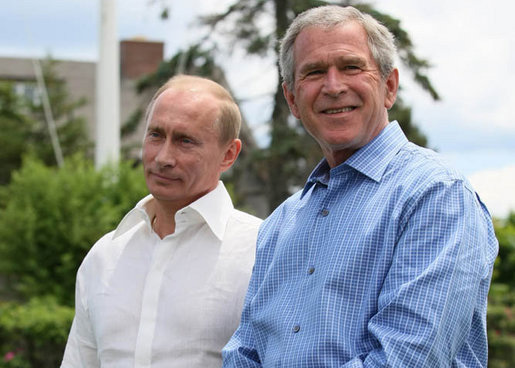
George W. Bush & Valdimir Putin. Picture: White House
In 2002, US President George W. Bush explained his position that “[n]o nation can negotiate with terrorists, for there is no way to make peace with those whose only goal is death.” While this exposes a rather one-dimensional understanding of terrorism, Mr. Bush is certainly not alone is his argumentation. Vladimir Putin, at that time president of the Russian Federation, stated in 2004 that “[t]he universally recognized method of fighting terrorism is denying any negotiations with terrorists because any contact with them encourages committing new, bloodier crimes.” What I am trying to find out is if the claim by these two (former) political leaders and decision-makers and many others, for example 60 percent of the respondends in a survey in the United States, is justified or not. But before we go into detail, we have to answer the question why it actually matters if they are right or wrong.

If it is true that negotiations with terrorists encourage them to commit even more attacks, diplomacy would be a poor strategy for policymakers. As terrorism studies are ultimately aimed at finding ways to respond to and counter terrorism, scholars and dedicated citicens (like you) would have to discourage politicians from engaging in negotiations with terrorists. This would have a major impact on ongoing negotiations and peace processes. It is, therefore, important to test the assumption to give fact-based advice to policymakers and to effectively support their fight against violence.

One argument against the claim that negotiating with terrorists encourages more terrorism is that, in fact, many governments do (openly or secretly) negotiate with organizations they label “terrorist”. This holds even for governments that publicly pronounce against such actions. According to Peter R. Neumann from London's King's College, “[w]hen it comes to negotiating with terrorists, there is a clear disconnect between what governments profess and what they actually do.” For him it is not the question if, but how to engage in negotiations with terrorists “in a way that minimizes the risk of setting dangerous precedents and destabilizing its political system.” If governments find the right strategy to engage in negotiations with terrorists, they have a chance to end terrorism or at least reduce violence; the British government’s negotiations with the IRA are a successful example.


In a TEDx Talk at the Columbia School of International and Public Affairs, Mitchell Reiss from the US State Department warns that not negotiating might mean to miss an opportunity to end the
killing and violence but also points out the long and difficult road to successful negotiations. Another
Gilad Shalit arriving at IDF airbase. Picture: IDF


scholar, Grant Wardlaw, says in his book Political Terrorism: Theory, Tactics and Counter-Measures (Cambridge (2)1989) about the US governments refusal to negotiate with terrorists: “This extreme
determination to adopt the hardline approach is only likely to reduce their options” (p. 73). A further argument for negotiations is the case of kidnapping or prisoner exchange. Even governments with rather strict policies towards terrorists agree at least sometimes to negotiate terms for a release of hostages to safe the lifes of their citizens. The prisoner exchange between Israel and the Hamas that freed IDF soldier Gilad Shalit is a famous example. It was widly and controversially disussed in the Israeli public. Some complained that the price was too high, others argued that terrorists should not be released at all and yet others were worried that negotiating with terrorists about hostage-release and the exchange of prisoners might incentivice further terrorist attacks. This claim would impicate that we should consider the kidnapping of Gilad Shalit and possible similar future events as acts of terrorism. This is problematic in many ways. Firstly, the status of the Hamas as a terrorist organization is internationally disputed. Furthermore, it is, after all, a democratically elected government. A discussion of the issue of state-terrorism would lead too far from our topic though. Secondly, in my opinion only one of the three requirements of my understanding of the term terrorism applies, namely the use of physical violence. I find the evidence for an attempt to spread fear not very compelling, especially since the Hamas demanded a ransom. I would, therefore, say that kidnapping-for-ransom does not constitute terrorism, particularly in cases in which the hostages are released. As a consequence, negotiations with terrorist groups about hostage release do not encourage more terrorism. The question if or if not they encourage kidnapping is a different one. At least in the case of Israel and the Hamas there haven't been any further incidences.

An argument that speaks for the claim that negotiating with terrorists encourages more terrorism is historical: Even though Nazi Germany was not a terror organization per definition, it can still serve as
British Prime Minister Chamberlain announcing "Peace in our Time”
an example on how negotiations (the conference in 1938 that led to the Munich Agreement) with a violent actor holding maximalist demands went terribly wrong. Furthermore, negotiating with terrorists gives them a feeling of legitimization that policymakers try to avoid. Another argument is that making compromises with terrorist organizations would encourage others to form terrorist groups and committ acts of terrorism, too. This would imply that (1) there are numerous individuals within a given society that are willing to commit crimes, die or become imprisoned in order to achieve their goals and that (2) there is a variety of limited objectives that individuals find worthy becoming terrorists for (even if it means their death) if there is a slight chance of achieving them. I personally disagree with this rational-choice-theory approach to individual decision-making, even though I have to admit that it is difficult to find proof for or against it in this particular case. It strongly depends on the kind of society in which the terrorist organization acts and recruits its members. In countries with a high degree of human development and easy access to information it will be more difficult to convince individuals that achieving a certain goal is worth accepting the very negative consequences of being member of a terrorist organization, while this might not always hold for developing countries.

Terrorism is oftentimes rooted in a major grievance that - at least sometimes - has to do with the way a government governs - or miscoverns. If the policymakers of a country don't want to negotiate with terrorists, they should at least consider weaker forms of engagement as it might help them to understand the grievance and find ways to tackle it. In the ideal (but admittedly rare) case, this could make a terrorist organization obsolete by destroying its basis.

Negotiating with terrorists might have negative consequences, but I strongly believe that there are cases in which the benefits outweigh the costs. It is always important to ask if an engagement can be fruitful, especially when dealing with groups holding maximalist demands. On the one hand it is easy to see how negotiations with for example a terrorist group promoting international jihad would be absolutely futile. This is because many groups holding maximalist demands do not even seek negotiations as they do not believe that a government would accept their conditions. Moreover, their objectives are completely opposed to the values of many societies and, therefore, disqualified as a basis of negotiatons. On the other hand there are cases in which negotiations might be a very helpful way to end political violence. Terrorist groups with limited demands like for example over territory are more likely to enter into negotiations and to actually agree to a compromise.

I believe that we cannot generalze on this issue. The assumption that negotiating with terrorists encourages even more terrorism is not completely wrong but also only partly true, depending on the type of group, e.g. if it holds limited or maximalist objectives, and the way the government is approaching negotiations. Negotiations with terrorist groups should, therefore, always be regarded as a tool of policymakers.