Friday, 13 June 2014

Insurgency and Chaos in Iraq. What is happening and why?

In Iraq, hell is unleashed as you might have heard in the media. A group of islamist insurgents called Islamic State in Iraq and Syria, or, in short, ISIS, is rapidly gaining ground in western and northern Iraq. The name might sound familiar to you if you follow the events in Syria, as ISIS is active in the civil war there as well. In this entry I will explain what happens in this part of the Middle East, why it happens and where the regional actors stand. In order to understand the complex situation, a large portion of this entry will look into the history and the events that led to the big mess that Iraq is now. Inspired by my co-blogger Alejandro’s examples, I will try to give an easy step-to-step introduction into the issue. If you find some statements to be oversimplified, I know, I left out many details, but this is meant to be an introduction, not a scientific study. I hope it gives you some interesting insights and helps you to understand the current situation in Iraq a bit better.

So let’s get started. These are the most important factors that have an impact on the current events in Iraq:

Sectarian factions in the Middle East

The Middle East is birthplace of many religions, of which the most well known are Judaism, Christianity and Islam. It is, among others, home to Orthodox and Catholic Christians, Druze, Jews and Muslims, the latter being by far the largest group. But as with most religions, Islam does not have one single mainstream branch or denomination but several. Examples might be Shia and Sunni Islam or Sufism. In the Middle East, Shiites (or Shias) and Sunnis (or Sunnites) form the majority. While the former believe that Prophet Muhammad’s son-in-law and cousin Ali is his successor and, therefore, first Caliph, the latter see Abu Bakr as the first Caliph and rightful successor. Other than Shiits, Sunni Muslims accept the sunna as a second source of islamic law and are often said to be more orthodox in their religious practices. Without going further into detail, it is important to know that while the two groups live together peacefully in many places of the Middle East, this is not so much the case in today’s Syria and Iraq, to say the least. But why is this so, what changed so dramatically in these two countries?


The second Iraq War. Image by Futuretrillionaire
The Iraq War and its aftermath

After the US led invasion and the toppling of Saddam Hussein and his Ba'ath Party regime in 2003, Iraq has been in a constant state of sectarian fightings. (If you are interested in some first hand insight, I can highly recommend Dexter Filkins’ brilliant book The Forever War.) The news about suicide attacks (often but not exclusively perpetrated by Sunni terrorists against Shiite civilian or against government targets) are so legion that the news media got tired of covering them as the readers/watchers got used to it and gradually lost interest. The reason for the fighting amongst sectarian factions is mainly to be found in the unstable political situation as a result of the invasion. While the population of Iraq is predominately Shiite, Saddam Hussein‘s regime was composed of Sunni Muslims. The often brutal suppression of the Shiite majority with the help of the regime’s security forces caused much suffering but also resulted in relative stability and peace due to the strength of the regime. On an unrelated note, Saddam Hussein’s Iraq also provided a counterbalance to Iran. With this rough but stable regime gone, Iraq fell into a spiral of sectarian fightings, chaos and insurgency with no end in sight. So far, the year 2007 has been the inglorious peek of terror, but this year’s atrocities are on a good way to overshadow even that. Here are some of the reasons for Iraq’s instability: After invading Iraq, the coalition forces crushed almost all Iraqi institutions, notably also the - predominantly Sunni - military. Tens of thousands of young men lost their jobs and perspective and were neglected by the now Shia government that basically turned the tables and marginalized the Sunni minority. The new government, lacking Saddam Hussein’s power to suppress their opposition,
Saddam Hussein in 1979
could not restrain these men from going underground, which many of them did, forming or joining criminal or islamist groups. Moreover, the new government is widely perceived to be a puppet of the US and enjoys little trust from its people. Another big disaster that led to the strengthening of al-Qaeda in Iraq was a consequence of the first big wave of terror in 2005. In order to push back islamist militants, the US armed Sunni tribes in Iraq’s western province Anbar and made the government promise that they will be integrated into Iraq’s regular security forces. At first, the plan seemed to work as the tribal militias achieved a number of initial military successes. But when it was the government’s turn to fulfill their promise, they backed down, creating just another batch of tens of thousands of disappointed, unemployed men belonging to the Sunni minority, which are, to make matters even worse, armed with US weapons. You can do the math yourself... The US simply failed to understand the consequences of their actions. Colin Powell, head of the US State Department during the second Iraq war warned President Bush with his iconic phrase “if you break it, you own it,” meaning that after toppling Saddam Hussein’s regime the US would have to take responsibility for Iraq. Instead, President Obama withdrew all troops in 2011, leaving behind a destabilized state that is incapable of protecting its own citizens. By now the horrifying number of up to 140,000 civilians fell victim to the ongoing violence since the US led invasion in 2003!

The Arab Spring and its effects in Syria

Syria, Iraq’s neighbor to the west, has been and is in parts still ruled by the Ba'ath Party, but this one is not to be confused with the Iraqi Ba'ath Party. They used to be just one, but split in 1966 and the two Ba'ath Parties formed the governments of their respective states. Their relationship was not always the best and the countries are quite different in many respects. Especially interesting for us is that, while predominantly Shiite Iraq was ruled by a minority of Sunnis, it is the other way round in
Bashar al-Assad. Image by Fabio R. Pozzebom
Syria. President Bashar al-Assad belongs to the religious group of Alawites, which is considered a sub-branch of Shia Islam. Its members are especially devoted to Prophet Muhammad’s son-in-law and cousin Ali. Members of this faith dominate the Syrian government and hold key positions in the military. Syria is also home to a large Christian population of about 2.5 million, but the majority of Syrians are Sunni Muslims. The government of Syria was certainly not very virtuous (by Western standards), but compared to Saddam Hussein’s Iraq, Syrians could live relatively undisturbed. This might make you wonder how Syria ended up as one of the world’s most notorious battlefields. Well, the answer to that is quite complicated, but I’ll break it down to the most prominent cause: the so-called Arab Spring. It started in Tunisia in December 2010 as mass protests against (police) corruption and went viral in many countries in North Africa and the Middle East in the following month. A number of governments were overthrown in an attempt to achieve or strengthen democracy and civil participation. The trend also spread in Syria, which led to large but peaceful demonstrations, demanding democratic change. In a woeful move, the government, unable to cope with the situation, ordered the military to open fire on the protesters. Within weeks, what started as peaceful protests turned into a bloody civil war that is still raging today. Deserted soldiers formed the Free Syrian Army, but liberal forces like them are increasingly outnumbered by islamist militias that have established a strong presence in the “liberated” territories in Syria’s north. The strongest group among them is the al-Qaeda affiliated “Islamic State in Iraq and Syria” (ISIS). Their target is quite obvious (an islamic state on the territory of Iraq and Syria in succession of the Caliphate), but why exactly do they want such a thing?

A very brief introduction into the Arab World and islamist fundamentalism

For many people, islamist fundamentalism was an unfamiliar concept before September 11, 2001. From this day on the perception of islamic societies changed fundamentally, especially in the West. So lets have a quick look on the history of ideas in the Middle East. Until the beginning of the 20th century, large parts of the Arab world were ruled by the Ottoman Empire. It’s subjects did not define themselves so much by their nationality but rather by their religion and tribal affiliation. Broadly speaking, the Ottoman Empire was perceived as the protecting power of Middle Eastern Muslims. With its collapse in the aftermath of World War I, European powers, especially England and France colonized the people on its territory and created states with often arbitrary boarders. For example, Winston Churchill, then state secretary for the colonies and later Prime Minister of the United Kingdom claimed that the creation of Trans-Jordan (today’s Kingdom of Jordan) in 1921 was made “with the stroke of a pen, one Sunday afternoon in Cairo”, an afternoon that, according to some, followed a particularly liquid lunch.
Supporters of the Muslim Brotherhood at a rally for President Morsi
Defeated by European powers and their modern technology, intellectuals in the Arab world started developing alternative ideas to the weak status quo, ranging from a return to Islam and spirituality (as promoted by the Muslim Brotherhood in Egypt) to secularism and European style modernization (Turkey’s reformer Kemal Atatürk is a famous representative of the latter). Over the years, new ideas were developed and implemented, from Arab nationalism to Arab socialism. The founding of Israel in 1948 as the sole non-muslim and non-arab state in the region also had a deep impact on its Middle Eastern neighbors and to a certain degree unified them in their (fruitless) fight against it. But over the decades, the spirit of optimism faded and made way for resignation. Arab nationalism as well as Arab socialism had failed and multiple attempts to modernize their societies were rejected by religious authorities. Many Muslims in Arab countries turned their back on politics and turned towards religion instead. The growing urbanization and drift to the cities of large parts of the commonly more conservative rural population was another of multiple reasons for Islam’s renewed importance in everyday life. Political stagnation, Islam’s rising influence on people’s lives and the marginalization of the youth created a dangerous cocktail that eventually led to the emergence of islamist extremism. Just to make this clear, I am not saying that Middle Eastern countries or governments are islamist extremists. But they were a (largely involuntary) breeding ground for violent fundamentalist groups that pose a threat to international security. The difference between groups like the PLO or even the Hizbollah and organizations like al-Qaeda or ISIS is their motivation and, therefore, level of threat on the international stage. While the former are at least primarily motivated by political targets that focus on their area, the latter follow religious rules and have international aspirations. Now there is one more thing, but let me say this first: I am by all means far from lumping together peaceful believers with terrorists, but to understand the whole story, it has to be mentioned that many (but not all!) islamist extremist groups that resort to terrorism are composed of Sunni Muslims. For example, most of the horrid suicide attacks on civilians and the government in Iraq following the US led invasion were perpetrated by Sunni terrorists. The Afghan Taliban are Sunnis (predominantly Pashtuns, Afghanistan’s largest ethnic group) as well as the members of al-Qaeda and ISIS. In the Southeast Asian context, the Abu Sayyaf Group (ASG) and Jemaah Islamiyah (JI) are composed of Sunni Muslims as well. Again, I want to make it very clear the I am far from saying that all Sunni Muslims are islamist terrorists, on the contrary, the vast majority of Sunni Muslims just want to live in peace like you and me, but it is hard to deny the fact that many islamist terrorists come from this branch of Islam. Of course, Sunni Islam are the largest denomination of Islam, but this is not the only reason for their predominance in islamist terror-organizations.
The site of a car bombing in Bagdad in 2007. Image by Jim Gordon

Who are these insurgents and what do they want in Iraq?

As you have certainly heard, Iraq is under attack by the group “Islamic State in Iraq and Syria” (ISIS). They are one of the islamist militant groups that fight the government (and sometimes the more liberal rebels) in Syria and holds large territories in the northern part of the country. They are the main reason for the US’ reluctance to support the Syrian rebels with military equipment as they are worried that it might end up in ISIS’ and other islamists' hands. This is a lesson learned from Afghanistan, where the US armed the mujahideen in their resistance to the Soviets in the 1980s. Part of these very same mujahideen later became known by the name Taliban. Another, though less famous example is the above-mentioned support of Sunni tribal militias in Iraq in 2005. But back to the ISIS. Apart from it’s strongholds in Syria, they also spread their influence over the boarder into Iraq’s western province of Anbar, from where they are now unleashing their attacks on parts of Iraq. In fact, “Islamic State in Iraq and Syria” is quite a misnomer as ISIS’ ultimate target is the “re-erection” of the Caliphate and the “liberation” of Jerusalem. In the areas that were unfortunate enough to be “liberated” already, ISIS is implementing strict rules based on a primitive interpretation of the sharia. Without going too much into detail, just revisit the Taliban’s “Islamic Emirate of Afghanistan” from 1996 to 2001. That’s pretty much it. ISIS is an offshoot of al-Qaeda and supported by private donations from the Arab Peninsular, especially Saudi Arabia. But actually ISIS can x funding off its list for a while since they conquered Mosul, Iraq's second-largest and predominantly Sunni city, and looted almost half a billion (!) dollars from the city's central bank, which instantly made them the world's richest terrorist organization. The Iraqi Army also left much of its modern equipment, so prepare yourself to see images of insurgents deploying artillery and firing M16 rifles from Humvee jeeps, or, once ISIS has figured out how to use them, flying in materiel with their cargo planes or giving air support with UH-60 Blackhawk helicopters! By now, Iraq’s Prime Minister Nouri al-Maliki and his government have lost control of many parts of western and northern Iraq, including the cities of Fallujah, Ramadi, Mosul and Tikrit, the birthplace of Saddam Hussein and home to many of his cronies. According to the latest news, Tikrit was retaken by the Iraqi Army. In any case, ISIS’ troops are only 90 kilometers (56 miles) away from Iraq’s capitol Bagdad and will most likely try to use their momentum to further advance. In other words, it’s high time to understand what’s going on and, well, do something. 

Apart from ISIS and Iraq’s government, who are the main characters?

We talked already about Iraq’s government and about ISIS, now it is time to see who else in the Middle East has an interest in the regions power relations. So let’s go through the parties that are involved in the insurgency in Iraq.

Iran: Predominantly Shiite (and also ruled by a Shiite government), Iran was a natural enemy of Saddam Hussein’s Iraq. The bloody Iran-Iraq War from 1980 to 1988 (that ended with a military stalemate) can serve as an example for this. For Iran, the toppling of Iraq’s dictatorship was a game-changer. Iraq’s new, Shiite government is seen as an ally rather than an opponent, much to the dissatisfaction of Saudi Arabia, the second powerful player in the Gulf region. Iran has not many friends in the Middle East, but is on good terms with Assad's Syria and Maliki's Iraq. You can imagine that the Islamic Republic is more than concerned that ISIS is destabilizing exactly those two countries. In this context it is not surprising that Iran started deploying its Revolutionary Guards in Iraq to fight the Sunni insurgents.

Saudi Arabia: The Kingdom’s predominant denomination is Wahhabism, if you will a simplified form of Sunni Islam. If you have heard stories about insurgents destroying shrines of Muslim saints, that’s an idea derived from Wahhabism, where the worship of anyone but Allah is understood as blasphemy. It is, therefore, not surprising that quite many of ISIS’ foreign fighters come from Saudi Arabia and that private donors from the kingdom support the islamist militia. The monarchy is getting increasingly worried about this, as it fears returning fighters might perpetrate terror attacks at home. But on the other hand, everything that weakens Iran is useful for Saudi Arabia as the two states compete over the dominance in the region since the balance of power was destroyed with the overthrowing of Hussein’s Iraq.

Turkey: The successor of the Ottoman Empire traditionally maintained good relations with the Syrian Assad regime, but terminated their friendship following the outbreak of the Syrian Civil War. In blind support of everyone who was willing to fight the Syrian regime, Turkey opened its boarders in both directions, allowing young and enthusiastic islamists to enter Syria and wounded or war-worn islamists to retreat to Turkey. This week Turkey’s support for extremists backfired when 80 Turkish citizens, among them the country's consul general, were abducted by ISIS. It is not completely unimaginable that Turkey's military, on the alert for the past three years and prepared for an intervention in Syria, could be depoyed in Iraq.

The Kurds: The Kurds are an ethnic group (they are not Arabs) that is spread in several countries in the northern region of the Middle East. Having their own autonomous region in northern Iraq, the Kurds there form the last stronghold against ISIS’ fighters in this area. The only problem: As most autonomous regions, the Kurds are suspected of aspiring independence (as they did in Turkey, maybe you have heard of the PKK). A weak Iraqi government that relies on the help of Kurds, that seems to be a problem, especially since their region is rich in oil. The Kurds’ secession would be a major setback for Iraq.

So much about the background of the current events in Iraq and the regional actors. I hope my introduction helps you a little bit the next time you hear the news from the Middle East! As always, I would be more than happy to hear your opinions, critiques and general comments!

Friday, 30 May 2014

Expert interview with Prof. Rohan Gunaratna


Earlier this year I got the great opportunity to interview Prof. Rohan Gunaratna, head of the prestigious Singapore-based International Centre for Political Violence and Terrorism Research. I conducted the interview to get a deeper understanding of terrorism, Non-State Armed Groups (NSAG) and illicit arms trade in the Philippines that will help me in writing my master thesis, but Prof. Gunaratna agreed that I publish the interview on International Security Issues as well.

--------------------------------------------------------------------------------------------------------------------------------

ISI: Prof. Gunaratna, in your article Understanding the Radical Mindset from September 2012 you quote Umar Patek from Jamaah al Islamiyya (JI). He said that his motivation to take part in armed violence and terrorism is Muslim self-defense. In the context of Small Arms and Light Weapons (SALW) that raises the question if it is the availability of SALW that causes armed conflict or if it is that terrorist groups and Non-State Armed Groups (NSAG) want to use armed violence and, therefore, have the demand for SALW. Or is it an entirely different reason?

Prof. Gunaratna: Firstly, terrorist groups are always looking for weapons because terrorist groups know that without weapons they cannot mount attacks. So a terrorist group will have the intention to do attacks but no operational capability. Operational capability comes with training and with weapons. So one part of the strategy to fight political violence or illegal violence, terrorist violence is to counter the intentions, to create more pathways for peace. But we also have to deny access to weaponry and access to training. We have to regulate both availability to weapons or easy access to weapons, access by unauthorized persons, plus we must control those who provide training without a government organization or approval. These persons should be persecuted and put in prison, because those who have the specialist knowledge to provide training should be held liable and held accountable. Those who provide training plus those who sell weapons illegally should be sent to prison, like for a hundred years where they will not come out of prison. You have to have very harsh laws. You have to confiscate their property and you have to also ensure that they do not come out of prison because these weapons kill a lot of people.

ISI: Right now there are many “future terrorists” and irregular soldiers travelling to Syria to get their battlefield experience there. This is probably also a big threat.

Prof. Gunaratna: Correct. Syria is the new Afghanistan. With regard to Afghanistan, it produced the last generation of terrorists and Syria is now producing the next generation of terrorists.

ISI: How do NSAGs and terrorist groups in the Philippines and in Southeast Asia acquire arms and where do those arms come from?

Prof. Gunaratna: In the Philippines there are three principal sources of weapons. One is, the New People’s Army (NPA) acquires weapons from official foreign sources. We also saw that even JI tried to buy weapons with MILF (Moro Islamic Liberation Front). MILF and JI together had a plot to buy weapons from official foreign sources as well. This is the first source of weapons. Certain governments are acting illegally, selling weapons to various NSAGs. A second source of weapons is private arms dealers, people in Hong Kong, people in China, people in Australia. The third source of weapons is what these groups get from the military and the police. They buy weapons from state sources that are corrupt.

ISI: In the western perception, terrorist attacks are often conducted using explosives like IEDs (improvised explosive device). Has the availability of SALW in the region an impact on terrorism?

Prof. Gunaratna: In the Philippines, the Abu Sayyaf were experts in kidnapping but not in bomb attacks. They developed the capability to do bomb attacks because of the Abu Sayyaf integration with Jamaah al Islamiyya. JI is now working with Abu Sayyaf. Before, JI’s sponsor was MILF because MILF had a major training camp in a place next to a camp (Abu Bakar) called Hudaibiya and after Hudaibiya they moved the location to Jabbar Kubar 1 and Jabbar Kubar 2. But now MILF, under the new leadership, Hadji Murad is not providing assistance to JI but Abu Sayyaf is providing that link and what we are keen to see disrupted is that relationship, because it is the JI relationship that gives Abu Sayyaf the capability to do the bombings. As you know 80 to 90 percent of terrorist attacks use guns or bombs. This is not different in the Philippines. Certainly, the bombing capability of Abu Sayyaf, of the Rajah Sulaiman Revolutionary Movement that had that capability and the MILF special operations group created a lot of chaos. We must specifically control the flow of explosives. This is a major concern because a lot of people die because of explosives. Firearms are dangerous, but explosives are even more dangerous.

ISI: Prof. Gunaratna, thank you very much for the interview.

Wednesday, 21 May 2014

Explosive Remnants of War in Mindanao - The Threat and the Solution

The promotion of international security and the fight against political violence and its consequences are issues not limited to high politics but often have their base on the grass root level. For example, countless NGOs and volunteers work in areas affected by armed conflict, offering help and support to the most vulnerable - the civilian population. Their work is often very difficult and not seldom dangerous. In this entry I want to share my recent experiences of witnessing and taking part in the important work of NGOs on the grass root level.

FSD staff and trainees after an MRE session. Source: FSD
Thanks to my organization’s (South-South Network for Non-State Armed Group Engagement, SSN) close ties with the Philippine Campaign to Ban Landmines (PCBL) I got the chance to become sort of their “guest intern”, fly to Cotabato City in Western Mindanao and take part in a one week long train-the-trainer workshop hosted by the Swiss Foundation for Mine-Action (FSD). After the workshop I also had some time for research regarding my master thesis and field of particular interest, the situation of small arms and light weapons (SALW) diffusion and trade in the region, which will certainly be a topic for a future blog-post.

Before actually going to Cotabato City and Maguindanao, I was thoroughly warned by many of my friends in Manila about the dangers and the security situation in Mindanao, especially in the southern and western parts of the island. Indeed, there have been incidences and kidnapping is still a considerable threat especially to foreigners, but on the other hand there haven’t been any recent reports and the signing of the Comprehensive Agreement on the Bangsamoro (CAB) between the leadership of the Moro Islamic Liberation Front (MILF) and the Government of the Republic of the Philippines gave me some additional hope that things would go well, so I informed my embassy and booked my ticket.

One short week later I found myself in a long line of people waiting to board flight EJ 887 to Cotabato City. As expected, I stood out in the crowd, as I was the sole foreigner, a fact that didn’t remain unnoticed by the lady in front of me. After we had a short and friendly chat she lowered her voice, leaned forward and asked me with a troubled look on her face: “But you are informed, aren’t you?” “Informed of what?” I wanted to ask, but of course I knew what she meant. The fact that she didn’t even see the need to explain what I should be informed of, that the security situation was so obviously the major issue for a foreigner when going to Cotabato City did indeed not help me much in suppressing my doubts, but here I was, boarding the plane anyways.

As it turned out, all the warnings were quite exaggerated, the situation is really not as bad as many people, especially those in Manila, believe it is. Of course one has to be careful and for example not walk around alone at night, but this is advisable not only for Western Mindanao. For the first week I stayed at the dormitory of the center where the workshop took place, an unguarded compound with an easy to climb gate (I climbed it twice myself because I missed the dorm’s curfew), but everything was perfectly fine.

Our MRE train-the-trainer workshop in Cotabato City. Source: FSD
The workshop itself started the day after my arrival and was held by the FSD staff. We, the trainees, twelve of them from the region and me, were about to become Mine Risk Education (MRE) Facilitators. Now if you know a thing or two about armed violence in the Philippines you might wonder why the workshop was about the risk of landmines as there are only few cases in the Philippines in which these were used. Currently, only the New People’s Army (NPA) employs mines, but there has been a recent incident in which the Bangsamoro Islamic Freedom Fighters (BIFF), a breakaway group of the MILF, made use of a roadside bomb as well. To be precise, when we use the term landmine, we usually talk about victim-activated anti-personnel mines (APMs), which are banned under the 1997 Ottawa Treaty. This means that landmines that kill or injure indiscriminately anybody who steps on them / trips the tripwire etc. are banned, whereas command-detonated APMs like the so-called Claymore mines (a U.S.-designed (M18A1) directional APM which can be either command or victim-activated and even both at the same time because of it’s two fuses) do not fall under the ban of the 1997 Ottawa Treaty. This is mainly because command-detonated mines are presumably discriminate as they are (ideally) detonated only against legitimate military targets. Naturally, this requires a person observing and detonating the landmine manually, usually electronically, when a military target approaches. Command-detonated mines are also more likely to be removed in case they were not detonated, while victim-activated landmines usually stay in the ground until someone “activates” them. As you can imagine, the employment of command-detonated APMs is a tactic with little use for the Armed Forces of the Philippines (AFP), but a quite powerful method of guerilla warfare.

Different types of (defused) UXOs and explosives. Source: Markus Schindler
“But if landmines are not a big issue in the Philippines, what was the workshop all about?” you might wonder. Well, landmines are not the only explosive remnants of war (ERW) that still pose a threat to the civilian population. MRE in the Philippines, therefore, focuses on unexploded ordnance (UXO), that means projectiles like shells, mortar bombs, but also rockets, various types of grenades, aircraft bombs and even improvised explosive devices (IEDs) that were fired but that did not explode. There might be a variety of reasons why the UXO did not detonate, but this does not make much of a difference for the people who discover them, as of course only experts can deal with such dangerous explosives.

The purpose of MRE in the Philippines is to reduce the risk of injury or death from UXOs by raising awareness and promoting behavioral change. By training this batch of community workers from various local NGOs, the FSD created a new group of MRE Facilitators. These volunteers are now visiting communities that were affected by fighting to inform the locals and especially the children about the right behavior when discovering a UXO. There are four important steps that MRE sessions have to focus on in order to have a lasting impact on the community. The participants of an MRE session have to be able to (1) recognize the UXOs that are relevant in their region, (2) know in which areas UXOs can be found (which is basically everywhere), (3) learn what they should not do when discovering a UXO (there are numerous cases in which people were harmed or killed because they were unaware or underestimated the danger of UXOs) and finally (4) know about the right behavior when discovering a UXO.

Source: Markus Schindler
The workshop was really interesting, sometimes quite intense but in the end very rewarding. We were taught a lot about the impact of UXOs, may it be physical, psychological, socio-economic or even humanitarian, and we acquired skills in recognizing UXOs and even visited an army camp in Cotabato City to take a look at some of the explosives that pose a threat to the people in affected areas. We also learned about methods of teaching communities and children of different ages, preparing and planning MRE sessions and many more things that we would need in the coming days. The second part of the training was reserved for practical exercises. So we practiced. A lot. But well, we really had to, because when the exercises were done, we went to a community, split into four groups and actually held MRE sessions for the locals. An amazing experience, trust me, but this was only the beginning. We all gained much confidence in our MRE skills from it, so after a nice lunch-break at the impressive grand mosque of Cotabato we went into a small village next to the riverbank of the Rio Grande de Mindanao and started with house-to-house sessions. It didn’t take us long to realize that quite many people in the village had already encountered UXOs and, therefore, were at risk, so we decided to gather all the villagers and have a so-called emergency MRE session.

The Grand Mosque of Cotabato City. Source: Markus Schindler
As these experiences were already very exciting, the real hit was just about to happen. The next morning we came together to make our way to Camp Darapanan, the headquarters of the Moro Islamic Liberation Front (MILF), where we were already expected. The MILF-combatants were surprisingly friendly and waved us through their numerous checkpoints without asking questions or the appraising look one usually gets from the immigration officials at internationals airport, so we went straight to the camp’s school. Today we would hold MRE sessions for the many children that lived within Camp Darapanan, and, to put the cherry on the cake, a delegation of ambassadors from EU-countries (among them the German Ambassador to the Philippines, Thomas Ossowski) would watch our presentations and hand over our certificates.

The delegation of European ambassadors and diplomats presented certificates to the MRE trainees. Source: Markus Schindler
I also had the honor to shake hands with Thomas Ossowski, the German Ambassador to the Philippines. Source: German Embassy Manila
A friend of mine and I with a group of MILF combatants. Source: Markus Schindler
Needless to say, we had a lot of fun and the children at the camp enjoyed the MRE sessions as well as we were vigorously drilled by our Sri Lankan trainer Harshi to deliver our best performance. When time went by and we almost reached the end of our sessions, the ambassadors hadn’t arrived yet. But of course, they wanted to watch our MRE session, and you don’t want to disappoint ambassadors, so we stretched the thing. A lot.  Time went by very slowly and we had to improvise another hour or more, but when the delegation finally arrived everything happened really fast. I was surprised to see that a group of armed policemen convoyed the ambassadors to the camp but the MILF-combatants did not seem to worry about them, instead they talked to each other as if, well, they wouldn’t be the mortal enemies I always thought they’d be.

A group of MILF combatants at Camp Darapanan who kindly joined me for a picture. Source: Markus Schindler
After the week of training was over, the very motivated new team of MRE volunteers met up to plan their first MRE sessions and is very diligent ever after. If you want to check out their recent activities or express your support for their effort, you can find the Kutawato MRE Team on facebook.

The work that NGOs like the FSD is doing is not gaining much media attention, but their impact on the lives of people is enormous. I spend quite some time researching the negative consequences that arise from armed conflict for an affected region, and they are devastating. UXOs are certainly not the only problem, but their effects are some of the most direct to civilians and children in particular. I am very grateful that I was given the chance to experience and take part in these incredibly relevant activities. I hope the FSD and the growing number of MRE volunteer groups in Mindanao will succeed in increasing the safety of people who have to live in areas affected by armed violence.

Tuesday, 8 April 2014

The Ethical Dimension of Non-State Armed Groups (Part III)

Please note that this entry is part of an extended essay written by the author during his internship with the South-South Network on Non-State Armed Group Engagement (SSN). Nevertheless, the opinions expressed in this article are the author's own and do not necessarliy reflect the view of the SSN.

_____________________________________________________________________________________

As depicted in the previous part of this entry, most NSAGs have moral obligations not so different from the governments they often want to replace. This final part offers a discussion of particular elements of the ethical dimension of NSAGs that usually play a role within the activity of these groups, i.e. in violent conflict as well as in its aftermath.

The Bosnian village of Ljuta burns after heavy fighting between Bosnian Serbs and Muslims on July 22, 1992. Image from: Reuters/Stringer
Breaking the Law
For Milton Friedman, business organizations act socially responsible simply by meeting their objectives, with the limitation to stay “within the rules of the game”, which means to comply with the law. Governments, which are more comparable to NSAGs in terms of their moral dimension, usually follow their national law, too. This is, however, rather simple for them because governments usually posses the power to make and unmake law - particularly in less democratic countries. It must nevertheless be mentioned that it is especially but not only the governments of such countries that tend to disrespect certain international laws, which oftentimes causes grievance among the affected people, particularly when it comes to human rights law. NSAGs on the other hand often break both national and international law when they wrench the monopoly to the use of force from the state - with some notable exceptions. These include the right of rebellion as it is guaranteed in many national constitutions as well as in international law. It is, however, difficult to determine how often these regulations actually apply in the case of armed violence by NSAGs. Oftentimes quite the contrary is the case, with NSAGs breaking regulations of human rights law and international humanitarian law. Many consider human rights, to which all human beings are inherently entitled, as moral intuitions and the disrespecting of them, therefore, immoral and worthy of condemnation.

Political and Military Leadership   
Another ethical conflict is the lack of differentiation between two types of moral justification that apply in regards to armed violence. The “Just War Theory” distinguishes between jus ad bellum, meaning the moral justification for war and jus in bello, the moral justification of actions being taken during war. Traditionally it is the government or the parliament of a country that is concerned with the former, i.e. the decision to wage a war, while the latter, the decisions in the field are the business of the military commanders. This matters when we look at the issue from an ethical perspective. It means that, “[g]enerally speaking, a government is not to blame for the behavior of soldiers, and soldiers should not be blamed for the decisions made by the political class.“

With regards to our concern, NSAGs, we note a significant difference to the situation of nation states. The political head of NSAGs is more often than not identical with its military command. Therefore, there is only little or no division between the moral justification for engaging in armed violence and for actions take during this conflict. One implication is that, in the case of NSAGs, the leadership and its supporters, i.e. the insurgents are equally responsible for the decision to engage in armed violence and for the consequences of it. On the one hand, supporters of insurgencies would argue that the unity of jus ad bellum and jus in bello exposes the leadership of NSAGs to a wider range criticism because they have the nerve to shoulder their burden of responsibility. On the other hand, critics might hold that successful NSAGs that manage to overthrow and replace a government or gain control over a certain area in which they wield authority will be the equivalent of an unelected military dictatorship with fundamental lacks in the rule of law as well as checks and balances. Of course, if the government an NSAG fights looks like this already, the arguments would be undermined.

NSAG-Administration and Civil Society
When an NSAG is gaining new territory, they usually oust and often replace the official government of this area. The consequences of this transition depend on many factors and vary strongly. For example, are there any issues that might lead to violence towards the civilian population? There might be a variety of reasons, from ethnical over ideological or religious to tactical. Moreover, how is the NSAG structured? The levels of organization, hierarchy and discipline matter as well as the size of the group in respect to the extend and nature of its territory. These are only some examples of factors that determine the fate of a population under an NSAG’s administration, but there are also conditions that are common in almost all situations in which NSAGs control a territory.

With an NSAG as de facto government, the political administration as well as social services rest on military men. Legislative, judicature and executive power are often united in one hand. As history shows, it is not always easy to resist the temptation to abuse this power, even in the case of nationalist/separatist groups and rebels motivated by experiences of injustice and other grievances.

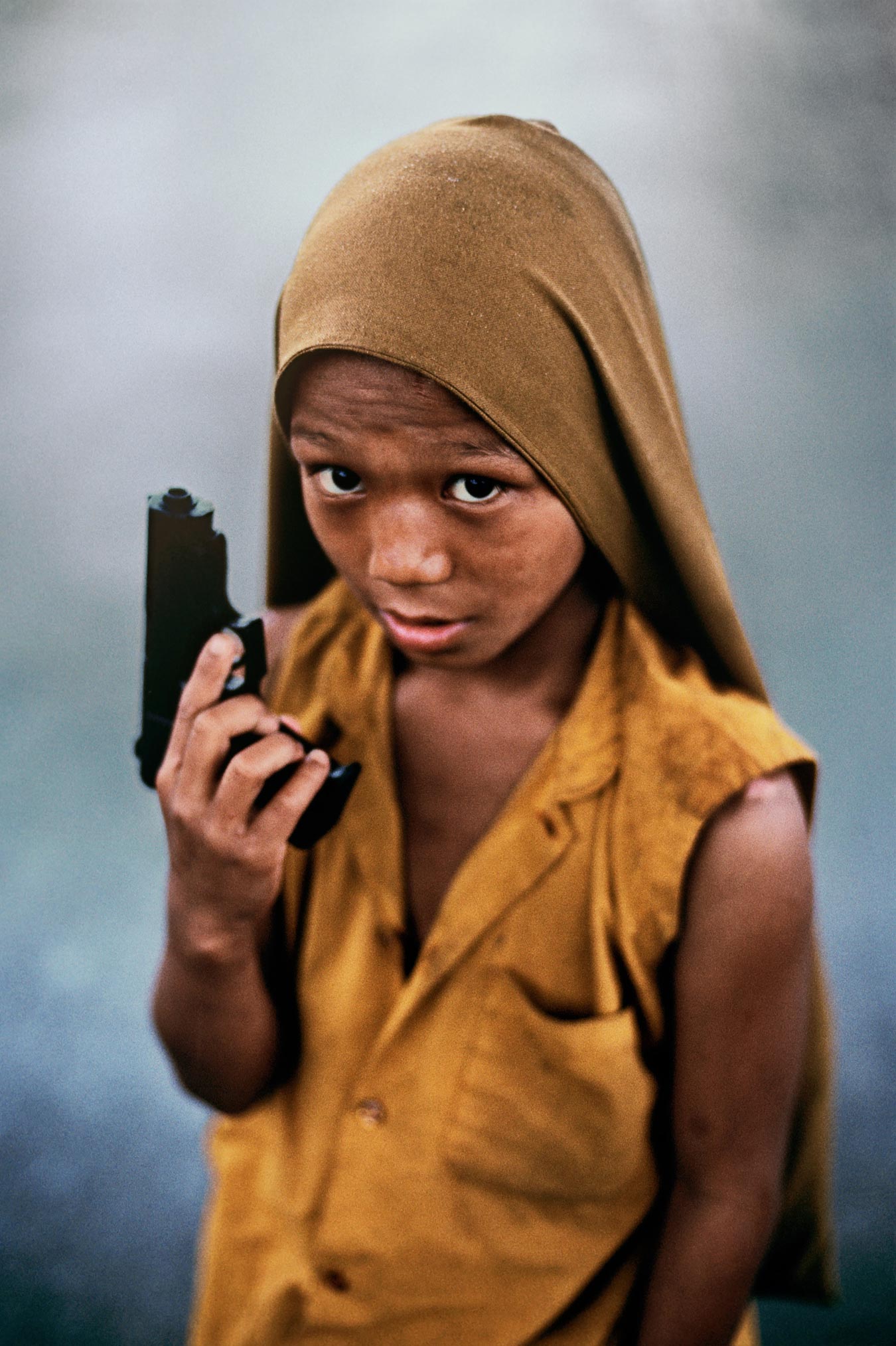
Child Soldier. Image by Steve McCurry
Another possible ethical conflict that arrises from NSAG administration is the fact that many fighters on all levels of the command chain might bear war traumata as results of the armed struggle. This includes the experiences they made during battle as well as possible atrocities, human rights and international humanitarian law violations they witnessed, committed themselves or were forced to commit. The effects of these experiences are especially severe when the fighting parties deploy child soldiers:

[C]hildren who had played an active part in the [Liberian civil] war had experience [sic] additional horrors and display symptoms of post-traumatic stress syndrome including nightmares, insomnia, bed-wetting, aggression and hyperactivity. Many observers comment on the inability of child soldiers to make informed moral choices about their actions, because of their youth and the atrocities they have witnessed and taken part in.

Having traumatized men in charge of the administration of a given population certainly poses a threat to peace-building and the resolution of the conflict, but it also complicates social coexistence. As mentioned in the first part of this entry, the collapse of social norms and practices is one of the attendant evils of civil wars. The effects of this breakdown become apparent with the increase in domestic violence, which occur not only during but also in the aftermath of violent conflicts: “One enduring impact of the militarization of daily life and the forging of militarized masculinities is an increase in domestic violence, a phenomenon noted in many post-conflict settings” (p. 21). (More on this here).

It takes much time and effort for a society to recover from the corrosive consequences of armed violence and to restore the social fabric that allows for peaceful coexistence. With regards to this, Soliman M. Santos, Jr. of the South-South Network for Non-State Armed Group Engagement states that “[v]alues must be transformed as much as society must be restructured since cultural values underlie and support societal structures.” With armed violence being responsible for these detriments, the effects of NSAG-activities on the moral principles of societies is certainly a topic that deserves more attention from the public as well as from scholars in the field of descriptive as well as normative ethics.

War within a Society
Unlike conventional interstate wars, fighters of NSAGs as participants of civil wars and other forms of insurgency often point their guns at members of their own society. Even if the waring parties have different economic, religious, ideological or ethnical backgrounds, in most cases they will have to find a way to coexist once the guns fall silent - an option that is very difficult but still preferable to the alternative: the forced displacement or even genocide of the defeated group. One can only imagine how difficult it is to gain or restore lost trust and establish social cooperation after a period of armed violence within a society. Since mutual trust is a basic prerequisite of shared moral convictions and the compliance with them, this issue is of high importance with respect to the ethical dimension of NSAGs.

Albert Einstein on the individual responsibility of soldiers
Individual Responsibility
Another relevant ethical dimension of NSAGs is the individual responsibility of its fighters. As human beings they have to be considered moral agents. In this context, it is important to note that many people agree that the moral rules for soldiers during war fundamentally differ from their peacetime equivalent (A matter that is profoundly examined by McMahan). This sentiment is a precondition for warfare and can, therefore, be observed in almost all cultures and throughout many centuries or even millennia. Today this notion is reflected in international humanitarian law, which does not prohibit war and killing in general but merely regulates which targets and ways of killing are allowed and prohibited, respectively. For soldiers, actions that are usually worthy of condemnation like for example the intentional killing of a complete stranger become morally acceptable or even worthy of praise during the time of war. The question we are faced with is if this notion equally holds for the fighter of NSAGs. Are they individually responsible for their actions during armed struggle, e.g. do they have to be considered murderers when they kill in battle? Indeed many governments that are confronted with political violence on their territory resort to the political maneuver of labeling the fighters of NSAGs as terrorists to suggest their moral inferiority (the Syrian government does not only call all Syrian opposition fighters without distinguishing terrorists, last month they even added the opposition delegates at the Geneva peace talks to a national terrorist list), but this should not distract us from the real question: In what respect do rebels or insurgents differ from regular soldiers in moral terms?

Bosnian Croat soldiers pass by the corpse of a Bosnian Serb soldier. Image by Tom Dubravec/AFP/Getty Images
One difference might be the motivation to join the armed forces of a state and an NSAG, respectively. While armed forces are usually used to maintain the status quo (on a national level), the creation of NSAGs is often the result of a certain grievance. Apart from motivations that are possibly similar like financial reasons, patriotism or social approval, regular soldiers might hold that they fight for stability and peace, while rebels would argue that they raised arms to fight against injustice or for better conditions.

Individually responsible or not, there are two exceptions regarding fighters of NSAGs. First, abducted adults do not give their consent to the actions the NSAG they belong to (in the truest sense of the word) forces them. This applies also to abducted child soldiers, which, moreover, do not necessarily have to be considered as persons and therefore moral agents, because they might - to a certain degree - lack the ability to make rational decisions.

Disruption of Development and Growth
In his famous paper Famine, Affluence, and Morality, philosopher Peter Singer argues that everyone who is able to relieve people from life-threatening poverty without sacrificing something of similar moral importance is obliged to do so, or, more generally: “if it is in our power to prevent something very bad from happening, without thereby sacrificing anything morally significant, we ought, morally, do so.” In reverse, this moral principle would prohibit any person to do any actions that cause poverty among a given population unless these actions also have consequences that are morally more significant. This utilitarian notion of a “moral cost-benefit analysis” of course holds for all negative effects of NSAG-activities, but in the case of the economic impact it is much easier to compare the outcome of both sides of the calculation - forming an NSAG and engaging in armed violence or accepting the status quo.

Civil wars and other forms of political violence often cause the destruction of physical capital, the reduction of investment in physical capital, the decrease in private investment and an interruption of production and market transaction. These consequences have to be taken into consideration in any discussion of the ethical dimension of NSAGs, especially in societies that are already struggling with poverty. Unfortunately, it is particularly those that are frequently plagued by armed violence, as the following graph indicates:
 

Conclusion
The unspeakable suffering of the victims of political violence in countries like Syria or the Democratic Republic of Congo and many other parts of the world make it impossible to ignore the ethical aspects that are associated with the activities of NSAGs. This does not mean that NSAGs are necessarily (solely) responsible for these ethical conflicts, but they are inextricably linked to their existence.

As I tried to show, NSAGs do not have any social responsibility that they are bound to besides their primary actions because they are predominately concerned with social matters, anyway. Similar to governments, they are also not bound by moral responsibility but rather (attempt to) serve an analogous function as morality: the regulation of social coexistence. In this role, their objectives and - to a certain degree - their actions can of course not be in contradiction to the moral convictions of their peer group. In this sense NSAGs are bound to moral convictions without actually being moral agents themselves.

The depicted ethical conflicts that arise from violent NSAG activities are only a sample, the range is almost indefinitely extendable and also covers issues like the lethal effects of battles as well as famine, disease and the destruction of health services as a result of armed violence, increased child mortality in poor conflict regions, the destruction and reduced investment in human capital, the diversion of public funds from education, wartime rapes, the increased production and trafficking of illicit drugs in many areas controlled by NSAGs, the weakening of state capability and the destruction of government services and, of course, the high probability of renewed armed conflicts after a civil war. Unfortunately, this list is far from complete. In the light of this it is all the more surprising that there is an exceptional lack of research in the field of ethical dimensions of NSAGs. I hope that this important but yet understudied research topic soon gains more attention from the public and also from scholars in the field of practical philosophy.

Wednesday, 26 March 2014

The Ethical Dimension of Non-State Armed Groups (Part II)

Please note that this entry is part of an extended essay written by the author during his internship with the South-South Network on Non-State Armed Group Engagement (SSN). Nevertheless, the opinions expressed in this article are the author's own and do not necessarliy reflect the view of the SSN.

_____________________________________________________________________________________

In part I of my entry on the ethical dimension of Non-State Armed Groups (NSAGs) I attempted to show why research and discussion of these issues matters and described the current state of research. This second part will focus on the theoretical background that is needed in order to introduce NSAGs into the ethical debate.

While policymakers, depending on their political attitude, often label NSAGs as either “terrorists” or “freedom fighters” to put a certain complexion on them, the term Non-State Armed Group is quite neutral and does not preset any normative position. Instead of labeling certain groups according to their actions, I will raise the question if and in what way NSAGs can be considered moral agents, i.e. entities that can be held morally responsible for their decisions and behavior. These considerations will be preceded by a short overview over important terms that are often used in ethical debates.

Ethical Terms - Ethics, Morals, Ethos, Law
In order to discuss ethical matters, some of the key terms need a short explanation. First of all, ethics itself is concerned with justifying moral theories and attitudes. It is, therefore, the science that deals with morals and ethos. For example, Immanuel Kant’s categorical imperative is a moral theory that determines what is good and bad, while the justification of why the categorical imperative should be applied is ethical reasoning. As seen in the example above, some moral theories are normative, i.e. they determine what is right and wrong, while a descriptive understanding of morals would explore existing concepts and look into what a certain society at a certain point in time accepts as generally good or desirable respectively as evil/bad/wrong and prohibited. A subcategory of morals is ethos, the moral attitude of a person or group. Finally, law consists of codified and compulsory norms including sanctions. In some societies, law and morals are very close or even identical, even though this is rather the exception than the rule. For example, certain aspects of administrative law are hardly based on moral intuition but more likely on rational considerations.

Moral or Social Responsibility of NSAGs?
First, as a matter of principle, moral agency requires the agent’s ability to make moral judgements and act with reference to right and wrong. NSAGs are usually hierarchically structured organizations composed of human beings. Successful NSAGs do not only engage in armed violence, but are also capable of raising funds, long-term strategic planning, logistic support and recruiting new members, skills that indicate that the (decision-making) leadership of NSAGs is sufficiently rational, a widely accepted precondition for moral agency. It is disputed, though, if being able to make moral judgements is equivalent with being required to actually do so, as some scholars hold that only actual people, not artificial organisms can have moral responsibilities. In the field of business ethics, this debate is ongoing for decades, with Nobel Prize winning economist Milton Friedman as protagonist of the idea that "there is one and only one social responsibility of business–to use it resources and engage in activities designed to increase its profits so long as it stays within the rules of the game, which is to say, engages in open and free competition without deception or fraud."

Portrait of Milton Friedman
Friedman does not speak of moral, but of social responsibility, an entity’s obligation to act to benefit society at large. Since he holds that enterprises benefit society simply by increasing their profit, this is their only social responsibility. It is however important to highlight that the fact that society profits from the success of its companies is rather a positive byproduct than the initial objective of business.

The question if an organization can be a moral agent depends on the understanding of morality itself. In a descriptive sense, morality is a means to make a human society function. From a historical perspective, the first organizations were of political and religious nature and oftentimes served the very same purpose, to enable and guide growing societies, intentionally or not. The invention of business entities created a new kind of organizations. Their purpose is not to benefit the society at large, but primarily their owners. However, because business entities offer solutions to societal needs (like products, services, jobs), their efforts happen to have positive effects on the society they operate in, which is precisely the “social responsibility” of business that Milton Friedman had in mind.

To sum up, rational individuals are moral agents with moral responsibilities, at least when they choose to live in a society, while traditional political organizations (governments) serve a similar purpose than morality. Since they are composed of rational individuals and act on behalf of their people, they are oftentimes required to act morally, too. Business organizations, however, do not share this moral responsibility, because they serve a different purpose. To ensure that they do not cause harm to a society, they are bound by laws. Nevertheless, many people demand social responsibility of business enterprises that goes beyond legal regulations because their conduct might have negative effects on societies that are hardly restrictable by law. If businesses are actually obliged to a socially acceptable conduct beyond legal regulations remains a matter of debate.

To integrate NSAGs in this system, the focus has to be on their (self-given) purpose. Many NSAGs are motivated by a certain or several grievances that are usually caused by the (in their perception) incompetence or morally objectionable behavior of the responsible governments. In case of the former justification, NSAGs argue that their political leaders could ensure a social coexistence (of their peer group) preferable to the current one, while in the case of the latter, ethical justification of their insurgency, NSAGs make themselves quasi moral agents as they show the capability to decide between good and bad and request moral behavior from others.

Of course there might be other motivations for NSAGs as well. Economic theories often treat insurgencies as criminal acts with the objective to gain power over natural resources or even hold that “where civil war is feasible it will occur without reference to motivation” (p. 2), a position that is not undisputed (See for instance here and here). In fact, some NSAGs use abduction on a massive scale to fill their rows. For example, almost 88% of the fighters of the Revolutionary United Front (RUF), a major NSAG during Sierra Leone’s Civil War, reported that they were abducted (p. 438). This is a clear sign that not all or only very few of the members of such NSAGs are motivated by societal grievances. One the other hand, events like the Arab Spring and its aftermath impressively demonstrate that the emergence of NSAGs as well as the associated insurgencies, violent conflicts and even civil wars can be motivated by grievances like experiences or perceptions of injustice. In the following I will focus on NSAGs with this sort of background because I regard any discussion of the ethical dimension of fundamentally inhuman, extremely cruel, exceedingly avaricious and alarmingly irrational non-state violent actors as redundant. This means that terrorist groups are also excluded from the following considerations as the immense immorality of their means - killing noncombatants to spread existential fear among a certain group of people - blocks the way for any further ethical discussion.

The leader of Uganda's Lord's Resistance Army rebels, Joseph Kony, surrounded by his officers in Nabanga, Sudan, August 1, 2006. Image Source: Reuters
A short excursus: fundamentally inhuman, extremely cruel, exceedingly avaricious and alarmingly irrational NSAGs
One example of high-level irrationality among NSAGs is the leadership of the so called Lord’s Resistance Army (LRA) that originates from Uganda and operated in Sudan (now South Sudan) and countries in Central Africa. Let me quote two news articles that illustrate what I mean by such NSAGs. You will certainly understand why I believe that any discussion of their ethical dimension is futile: “The rebel group began in 1986 as the Holy Spirit Movement, a Christian fundamentalist revolt under the leadership of a cult leader, Alice Lakwena, who claimed to give her followers immunity from bullets by anointing them with holy water”, while the current leader of the LRA, Joseph “Kony is a former faith healer who wears white robes and claims to talk directly to God. His followers embrace an eclectic group of beliefs, including prohibitions against riding bicycles, killing pigs and eating white-feathered chickens. Punishment is severe: the rebels have chopped off the feet of young men caught riding bicycles.” Furthermore, Mr. Kony “has nurtured a cult of personality, claiming he is visited by a multinational host of 13 spirits, including a Chinese phantom. Former abductees speak in awed terms of his "magical powers" and abrupt mood changes.” You can find the full articles here and here.

The interim result
NSAGs that are motivated by a certain grievance usually have the objective to eliminate this grievance for the benefit of their peer group. They are willing to fight an evil with another evil, i.e. armed violence and its harmful consequences. Given that the grievance that motivates them is real and can realistically be resolved by the use of force, the insurgents will most likely presuppose that the end justifies the means and, therefore, consider themselves as moral actors. As a political organization, they want to enhance a dysfunctional society. In this respect both NSAGs and governments serve a similar purpose than morality - at least from a very pragmatic and un-metaphysical perspective. They are, therefore, not moral agents with moral responsibility in the same way that individuals within a society are, but are still bound by the moral values of the peer group they are fighting for - similar to official governments. The term social responsibility does not apply to NSAGs as it is usually used in the context of organizations which’s actions are not primarily intended to affect a given society in any way, e.g. business enterprises.